Pol Pot
 Pol Pot - Wikipedia, the free encyclopedia
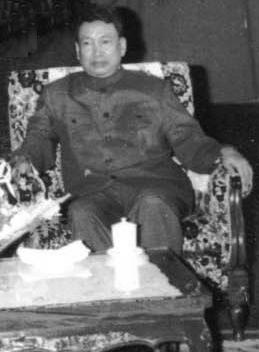
The Khmer Rouge took Phnom Penh on April 17, 1975. As the leader of the Communist Party, Saloth Sar was the designated leader of the new regime. He took the name "brother number one" and declared his nom de guerre Pol Pot. This has generally supposed to derive from Politique potentielle, the French equivalent of a phrase supposedly coined for him by the Chinese leadership. An alternative version of the origin of Pol Pot's name is from Philip Short, who states that Saloth Sar announced that he was adopting the name in July 1970 and suspects that it is derived from pol: “the Pols were royal slaves, an aboriginal people,” and that “Pot” was simply a “euphonic monosyllable” that he liked.[13]
A new constitution was adopted on January 5, 1976, officially altering the country's name to "Democratic Kampuchea." The newly established Representative Assembly held its first plenary meeting on April 11 – 13, electing a new government with Pol Pot as prime minister. His predecessor, Khieu Samphan was instead given the position of head of state as President of the State Presidium. Prince Sihanouk was given no role in the government and was placed under detention.
Immediately after the fall of Phnom Penh, the Khmer Rouge began to implement their concept of Year Zero and ordered the complete evacuation of Phnom Penh and all other recently captured major towns and cities. Those leaving were told that the evacuation was due to the threat of severe American bombing and it would last for no more than a few days.
Pol Pot and the Khmer Rouge had been evacuating captured urban areas for many years, but the evacuation of Phnom Penh was unique in scale. The first operations to evacuate urban areas occurred in 1968 in the Ratanakiri area and were aimed at moving people deeper into Khmer Rouge territory to better control them. From 1971–1973, the motivation changed. Pol Pot and the other senior leaders were frustrated that urban Cambodians were retaining old habits of trade and business. When all other methods had failed, evacuation to the countryside was adopted to solve the problem.
In 1976, people were reclassified as full-rights (base) people, candidates and depositees – so called because they included most of the new people who had been deposited from the cities into the communes. Depositees were marked for destruction. Their rations were reduced to two bowls of rice soup, or "p'baw" per day. This led to widespread starvation. "New people" were allegedly given no place in the elections taking place on March 20, 1976, despite the fact the constitution was said to have established universal suffrage for all Cambodians over age 18.

The Khmer Rouge leadership boasted over the state-controlled radio that only one or two million people were needed to build the new agrarian communist utopia. As for the others, as their proverb put it, "To keep you is no benefit, to destroy you is no loss."[14]
Hundreds of thousands of the new people, and later the depositees, were taken out in shackles to dig their own mass graves. Then the Khmer Rouge soldiers beat them to death with iron bars and hoes or buried them alive. A Khmer Rouge extermination prison directive ordered, "Bullets are not to be wasted." These mass graves are often referred to as The Killing Fields.